Anaheim, CA · Garage Door Service
What We Actually Check During a Service Call in Anaheim
A service call in Anaheim covers more than the obvious fix: homes built 1938-2007 need matching spring, track, and opener parts for the age of the house.
- Repairs & new doors
- Springs & openers
- Serving 5 nearby communities
What the Weather Here Does to It
Anaheim sits in a mild temperate band, so we don't get the freeze-thaw cracking that tears apart doors in colder states. That's the good news. The bad news is what mild weather does instead: it lets a garage door run through the same thermal cycle, uninterrupted, for decades. A steel panel that sits in direct sun hits a different temperature than the same panel an hour after sundown, and it does that every single day, all year, with no winter shutdown to slow the cycle down. On a door installed any time in that 1938-2007 range that's a lot of expansion and contraction on the same hinges, the same track bolts, the same weatherstrip. We're not chasing storm damage on these calls. We're chasing slow fatigue: hardened lubricant in the tracks, hairline cracks where a hinge meets an older panel, weatherstrip that's gone brittle from UV rather than cold. A service call here checks for wear that built up quietly over a lot of mild, unremarkable days, not for damage from one bad night.
Leaving It Alone
The median house in this service area was built around 1969, and most of the stock clusters in that 1960s-70s window across the named areas we work in. A door that's never been serviced on a house that age is usually still running on its original torsion spring and the drums that came with it - hardware that worked fine when it was installed and keeps working fine, right up until the spring snaps with no warning. Skipping service doesn't save the spring. It just moves the failure to a worse moment, usually when the cable's also worn thin enough to go with it. We'll say plainly: we don't push a full replacement on every older door. If the track's straight, the drums aren't cracked, and the opener's gear is intact, a spring swap and a lube job gets another good stretch out of original hardware. But on a door that's been ignored for years past when it should've been looked at, the honest call is sometimes that patching it costs more over time than replacing the unit outright.
The Situation
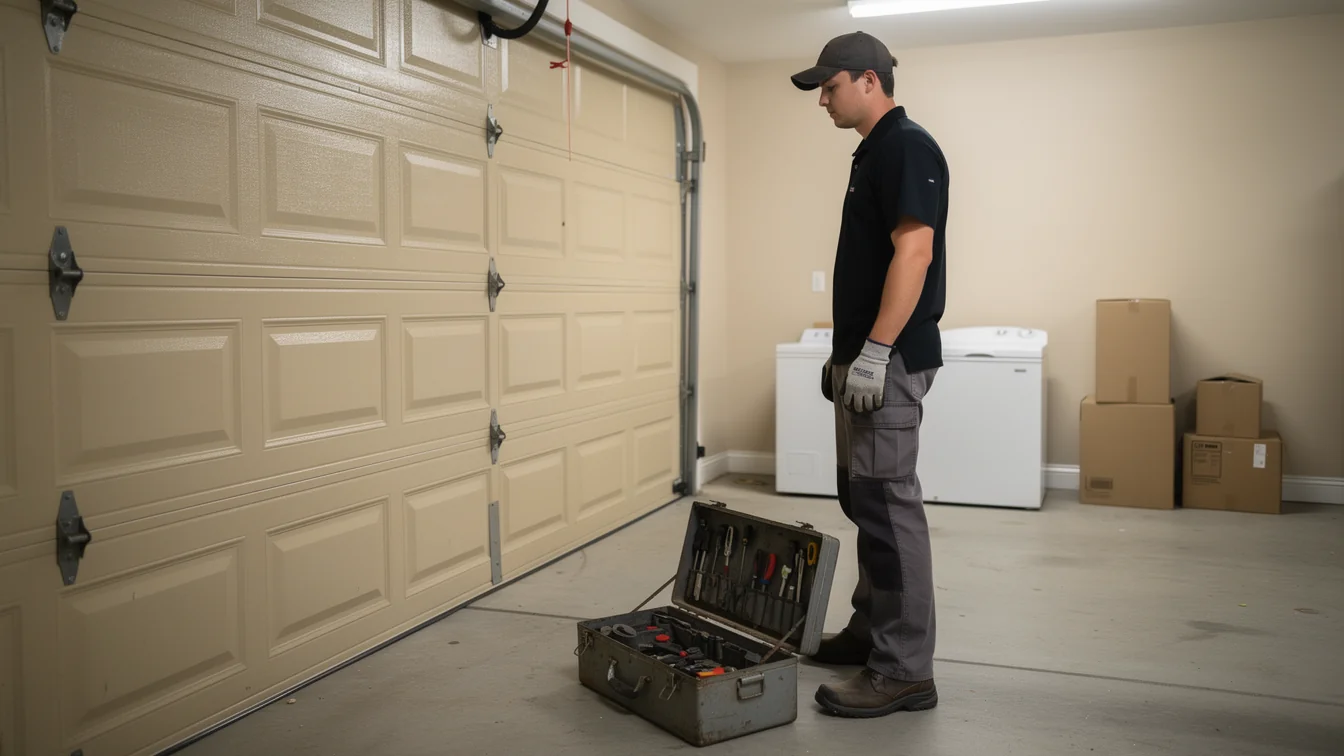
Across the 51 named areas in this service territory, the housing stock runs from 1938 up through 2007, but the center of gravity is squarely 1960s and 70s construction. That matters for a service call because the hardware era changes what we're walking in to look at. A door on a house from that window is more likely to have a one-piece panel on side-mounted torsion hardware than the sectional, center-mounted setups you'd find on something built in the 2000s. With 277,279 owner-occupied houses across this area and a median household income of $104,565, most of these are owners making a call on their own house, not a landlord managing a rental - so a service call usually comes with real questions about whether to fix or replace, not just a quick authorization. The actual visit covers the spring and cable tension, the track alignment, roller condition, the opener's force settings and gear, and the panel seams for rust or separation. On a house in that original-hardware window, we also check whether the drums match the cable gauge, since mismatched replacement parts from a prior repair are common on doors this age.
The Common Mistake
The mistake we see most on this side of town is assuming a garage door part is a garage door part - that any spring or any drum will do. On a house built in the 1960s or 70s, the torsion hardware often doesn't match what's sold off the shelf today, and a tech who swaps in the wrong gauge cable or an ill-fitted drum is setting up the next failure, not fixing this one. The second version of that mistake is waiting for a loud bang before calling anyone. A spring that's fraying doesn't usually give warning beyond a slight shudder or an opener that strains harder than it used to - subtle enough that an owner chalks it up to age and keeps opening the door anyway, right up until it doesn't open at all. On a mild-climate house where there's no seasonal reminder to check the garage, that drift goes unnoticed longer than it would somewhere with a hard winter forcing an annual look.
Frequently asked questions
Does Anaheim's climate mean less maintenance on my garage door?
Less damage from freeze-thaw cracking, yes, but not less wear. The mild temperate climate here means the door runs through daily heat-cool cycles year-round with no winter break, which fatigues hinges, track bolts, and weatherstrip steadily over the decades rather than all at once.
My house was built in the 1960s - does that change what a service call looks at?
Yes. Most of the stock across this service area clusters in that 1960s-70s window, and houses from then often still run original torsion hardware - drums and cables sized differently than what's sold new today. A service call on a house that age includes checking whether prior repairs used mismatched parts.
How do I know if a repair is worth it versus replacing the door?
It depends on the hardware's condition, not just its age. If the track's straight and the panel's intact, a spring or roller swap on original 1960s-70s hardware can be the right call. If multiple systems are failing at once, repair costs start adding up past what replacement costs.
Related garage door services in Anaheim
More garage door guides
Book garage door service in Anaheim
Call now or request a quote - tell us what the door is doing and where you are.