
Anaheim, CA · Garage Door Service
What Weather Seals and Drafts Really Mean for an Anaheim Garage Door
Anaheim homes mostly date to the 1960s-70s under a mild climate - here's why original seal tracks wear differently than you'd expect, and what to actually do about it.
- Repairs & new doors
- Springs & openers
- Serving 5 nearby communities
What the Weather Here Does to It
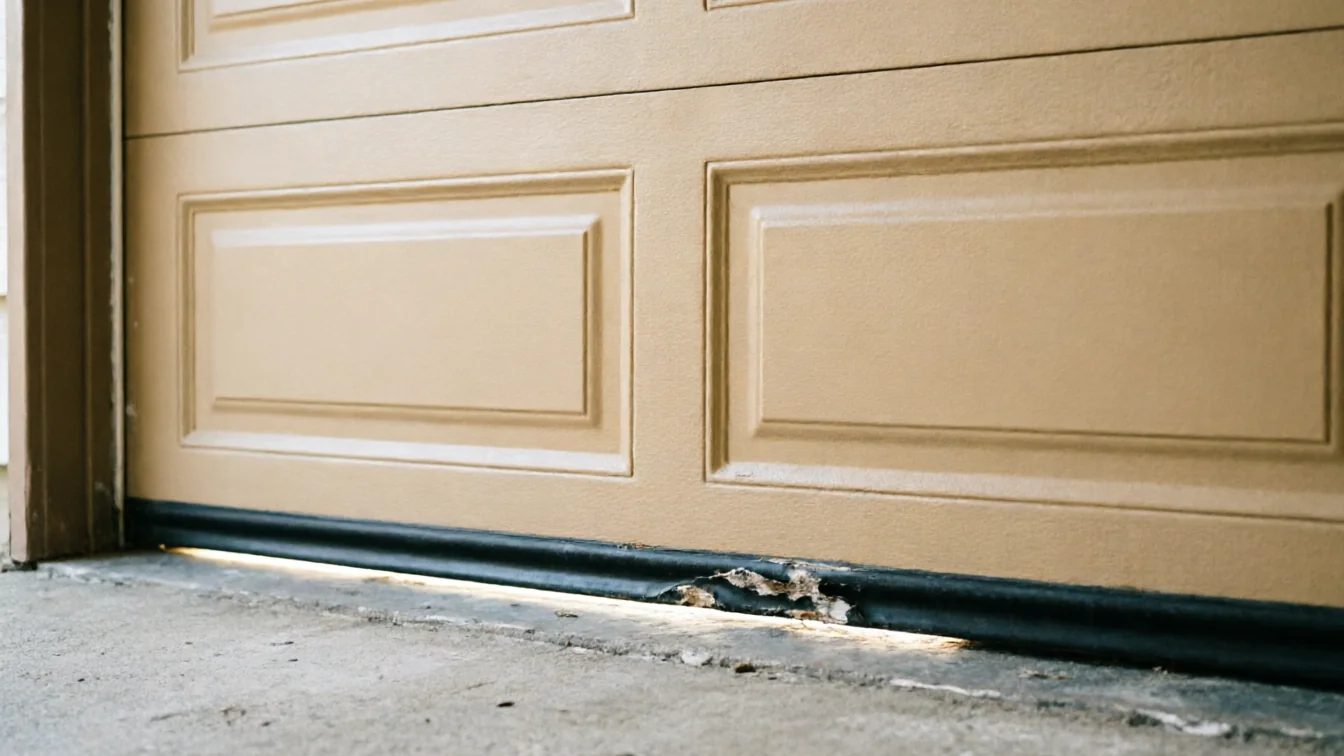
Anaheim sits in a mild temperate band, so the thing wearing out your bottom seal isn't frost heave or ice splitting the rubber - it's years of sun and heat cycling. A seal baked through hot afternoons and cooled every night for a decade doesn't crack the way it would in a freeze-thaw climate; it hardens, shrinks a little at a time, and pulls away from the slab at the corners first. You'll see daylight under the door before you ever feel a hard draft, because the gap grows gradually.
The astragal (the vertical seal where the door meets the jamb, if your door has one) goes the same way, usually faster on the side that gets afternoon sun. None of this is dramatic. It's slow, and that's exactly why people miss it - there's no single cold night that makes the problem obvious. You just notice one day that there's more dust on the garage floor near the door, or a draft on your ankles that wasn't there last year.
This isn't a defect. It's just what UV and heat do to rubber and vinyl over time, and it happens at a predictable rate depending on how old the seal already is.
Leaving It Alone
A seal that's lost its edge doesn't fail all at once, so it's easy to leave it. The immediate cost is small: a little dust, a little temperature swing in the garage, maybe a draft near the bottom corners on a windy day. None of that feels urgent.
What it does invite, over months, is water finding the same gap during a wet spell, and pests treating a quarter-inch gap as an open door - literally. Neither is a garage door problem at that point; it's a seal problem that's become a bigger problem because nobody replaced an eight-dollar part.
The other thing that happens is the gap grows unevenly. A seal that's hardened on one side and still flexible on the other starts letting the door rock slightly against the track as it closes, which over enough cycles puts uneven wear on the bottom roller. So the draft you ignored becomes a roller replacement a year or two later - not because the seal caused it directly, but because nothing got fixed while it was still a ten-minute job.
We're not going to tell you this is an emergency. It isn't. But it's also not nothing, and the fix gets more annoying the longer it waits.
The Situation
Housing in this area was mostly built between 1938 and 2007, with the typical house dating to around 1969, and the bulk of what we actually work on is 1960s and 70s construction across the neighborhoods we cover. That matters here specifically because seal tracks from that era aren't the same width as what ships on a modern door kit. A lot of these garages still have the original aluminum retainer channel along the bottom of the door, sized for a seal profile that hardware stores mostly stopped carrying years ago.
So the seal itself may be newer than the house - maybe it's been replaced once or twice - but the channel it sits in is original 1960s or 70s stock, and that channel dictates what bulb shape and width will actually hold. Push a standard big-box weatherstrip kit into an old narrow channel and it'll sit loose, twist, and pull out of the corners within a season, which just gets you back to square one faster.
This is the detail that gets missed: the problem usually isn't the rubber, it's whether the replacement matches the track that's actually there.
The Common Mistake
The common mistake is buying a universal weatherstrip kit off the shelf and assuming universal means it fits. On a door with the original track from the 1960s or 70s era that's typical of houses around here, a kit sized for modern retainer channel will sit proud, not seat fully, and start separating at the corners within a few months - right where the draft was in the first place.
The honest limitation on our end: we don't keep every retainer profile in the truck for the oldest doors. If your track is a narrow or discontinued width, that's sometimes a parts-order job, not a same-visit fix, and we'll tell you that up front rather than jam in something that won't hold.
The better approach is to measure the channel before buying anything, not the door's age or brand. A seal that matches the track will outlast two or three mismatched ones, and in a mild climate like this, a properly seated seal can go years before the sun finally gets to it. That's the real fix - not a thicker seal, the right-width one.
Frequently asked questions
Why does my garage door seal keep pulling away at the corners?
That's the most common failure pattern in this climate. Heat and sun cycling shrinks the rubber unevenly, and the corners move first because they flex the most every time the door closes. Once a corner lifts, dust and water start working the gap wider. Replacing the seal with one matched to your track width fixes it; a mismatched universal kit usually comes loose at the same corners again.
Do I need an insulated garage door because of the weather here?
Not for cold protection - the climate here is mild temperate, so you're not fighting freeze-thaw or heavy snow load. Insulation mainly helps with heat and noise if the garage sits under a bedroom or you use it as a workspace. For drafts specifically, a well-fitted bottom seal and astragal usually solve the problem on their own.
My house is from the 1960s - will a new seal kit actually fit?
Maybe not out of the box. A lot of houses from that era still have the original aluminum retainer channel, and it's often narrower than what current weatherstrip kits are sized for. Measure the channel width before you buy. If it's a discontinued width, that's sometimes a parts-order job rather than a same-day fix.
Related garage door services in Anaheim
More garage door guides
Book garage door service in Anaheim
Call now or request a quote - tell us what the door is doing and where you are.